System of Equations Solver
Calculate system of equations with a clear result and input validation.
Runs locally — files stay on your deviceWhat this tool does
System of Equations Solver calculate system of equations with a clear result and input validation. The page accepts a focused input and displays a result that can be copied into another workflow. Check generated values and remote responses against the actual destination before publishing or acting on the result. The supplied input is processed locally in the browser.
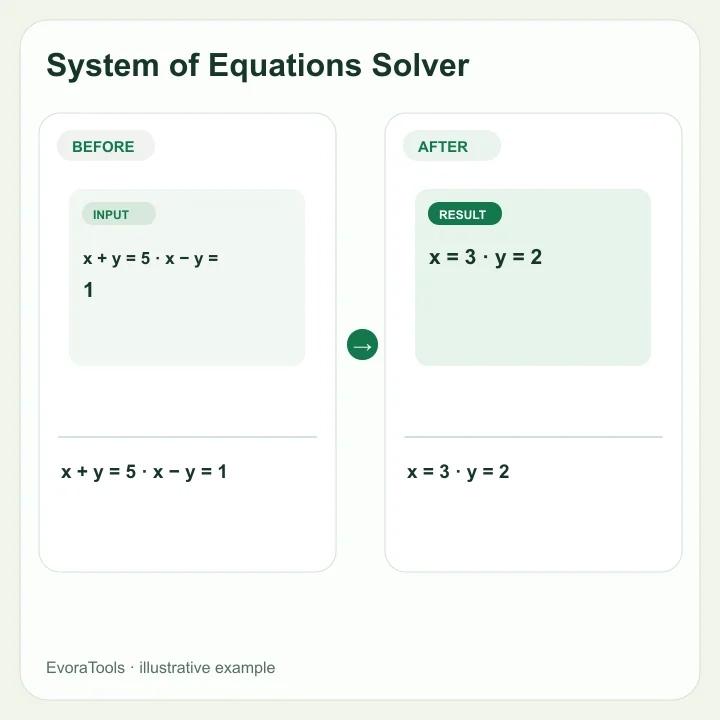
What is the quickest way to system of equations solver?
Enter A, B, C, D, E, F, run System of Equations Solver, and use the returned system of equations solver result.
Understanding system
A calculator turns defined numeric inputs into a result using an explicit formula. The interpretation of that result depends on using the correct quantities and units. For this page, the specific intent is system of equations solver; that boundary distinguishes it from broader tools in Math.
How it works
Enter the labeled values in the units shown. The calculator applies the formula, checks undefined cases such as division by zero, and formats the numeric result. Here, the relevant input is A, B, C, D, E, F, and the output is tailored to system of equations solver.
Key concepts
System of Equations Solver input and result
The input is A, B, C, D, E, F. The output represents system of equations solver, so review its format before reuse.
Why system of equations solver matters
A dedicated system of equations solver workflow reduces ambiguity: the operation has one stated intent and does not silently perform unrelated changes.
When to use it
- Check a manual calculation when the goal is system of equations solver.
- Compare two numeric scenarios when the goal is system of equations solver.
- Produce a repeatable result from clearly stated assumptions when the goal is system of equations solver.
When not to use it
- Confirm which value is the baseline before calculating a ratio or percentage.
- Do not report more precision than the inputs justify.
- Keep units consistent throughout the calculation.
Worked examples
Typical system task
- Input
A = 25; B = 25; C = 25; D = 25; E = 25; F = 25- Expected output
A system of equations solver result ready to review
This demonstrates the primary intent described by System of Equations Solver.
System of Equations Solver boundary check
- Input
A = 0; B = 0; C = 0; D = 0; E = 0; F = 0- Expected output
A validated system of equations solver result or a clear input error
Boundary values reveal the unit, syntax, range, and formatting assumptions specific to System of Equations Solver.
Using the System of Equations Solver output
- Input
A = 25; B = 25; C = 25; D = 25; E = 25; F = 25- Expected output
Output copied or downloaded for the destination system
The final destination determines the precision, format, and review needed after system of equations solver.
Common mistakes
Using the wrong system input
Confirm which value is the baseline before calculating a ratio or percentage. Correction: Confirm that A, B, C, D, E, F matches the page labels.
Skipping review after system of equations solver
Do not report more precision than the inputs justify. Correction: Compare the result with the original and its destination requirements.
Expecting System of Equations Solver to do more
Keep units consistent throughout the calculation. Correction: Use a related tool when the task extends beyond system of equations solver.
Best practices
- Keep an original copy before using System of Equations Solver.
- Use consistent input formats and units for system of equations solver.
- Review the System of Equations Solver result in the system where it will be used.
Related operations and differences
Linear Equation Solver
Choose Linear Equation Solver when you need to calculate linear equation with a clear result and input validation.; use System of Equations Solver specifically for system of equations solver.
Quadratic Equation Solver
Choose Quadratic Equation Solver when you need to calculate quadratic equation with a clear result and input validation.; use System of Equations Solver specifically for system of equations solver.
Combination Calculator
Choose Combination Calculator when you need to calculate combination with a clear result and input validation.; use System of Equations Solver specifically for system of equations solver.
Decimal to Fraction Converter
Choose Decimal to Fraction Converter when you need to calculate decimal to fraction with a clear result and input validation.; use System of Equations Solver specifically for system of equations solver.
Exponent Calculator
Choose Exponent Calculator when you need to calculate exponent with a clear result and input validation.; use System of Equations Solver specifically for system of equations solver.
Factorial Calculator
Choose Factorial Calculator when you need to calculate factorial with a clear result and input validation.; use System of Equations Solver specifically for system of equations solver.
Limitations and privacy
- Results use floating-point arithmetic and display rounding.
- The calculator models only the variables shown.
The supplied input is processed locally in this browser.
Frequently asked questions
What does System of Equations Solver do?
It calculate system of equations with a clear result and input validation. The operation is limited to system of equations solver and does not infer requirements that are not shown.
What input should I use for system of equations solver?
Use A, B, C, D, E, F in the units or format shown beside each field.
How should I interpret the System of Equations Solver result?
Treat the output as the direct result of system of equations solver. Check it in the destination context, especially when rounding, formatting, metadata, or irreversible file changes matter.
What limitations apply to System of Equations Solver?
Results use floating-point arithmetic and display rounding. The calculator models only the variables shown.