Linear Equation Solver
Calculate linear equation with a clear result and input validation.
Runs locally — files stay on your deviceWhat this tool does
Linear Equation Solver calculate linear equation with a clear result and input validation. The page accepts a focused input and displays a result that can be copied into another workflow. Check generated values and remote responses against the actual destination before publishing or acting on the result. The supplied input is processed locally in the browser.
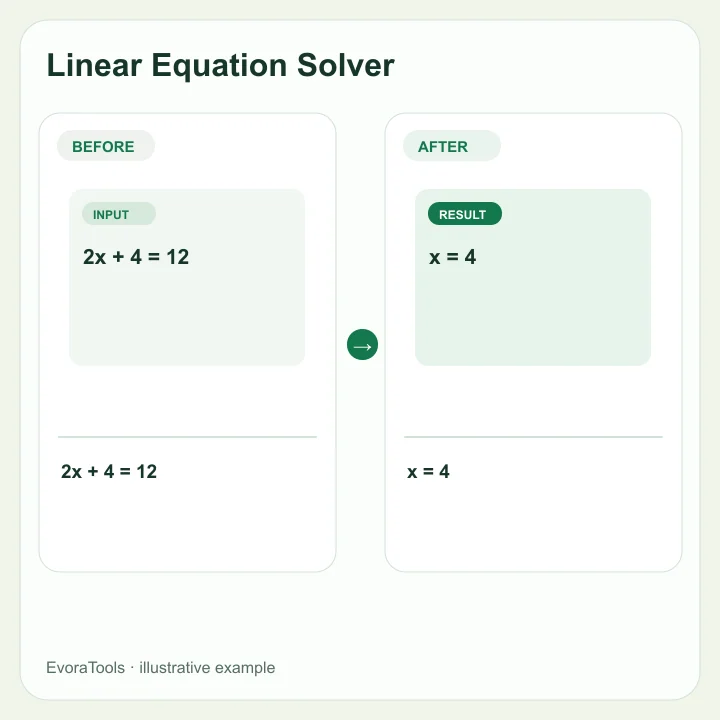
What is the quickest way to linear equation solver?
Enter A, B, run Linear Equation Solver, and use the returned linear equation solver result.
Understanding linear
A calculator turns defined numeric inputs into a result using an explicit formula. The interpretation of that result depends on using the correct quantities and units. For this page, the specific intent is linear equation solver; that boundary distinguishes it from broader tools in Math.
How it works
Enter the labeled values in the units shown. The calculator applies the formula, checks undefined cases such as division by zero, and formats the numeric result. Here, the relevant input is A, B, and the output is tailored to linear equation solver.
Key concepts
Linear Equation Solver input and result
The input is A, B. The output represents linear equation solver, so review its format before reuse.
Why linear equation solver matters
A dedicated linear equation solver workflow reduces ambiguity: the operation has one stated intent and does not silently perform unrelated changes.
When to use it
- Check a manual calculation when the goal is linear equation solver.
- Compare two numeric scenarios when the goal is linear equation solver.
- Produce a repeatable result from clearly stated assumptions when the goal is linear equation solver.
When not to use it
- Confirm which value is the baseline before calculating a ratio or percentage.
- Do not report more precision than the inputs justify.
- Keep units consistent throughout the calculation.
Worked examples
Typical linear task
- Input
A = 25; B = 25- Expected output
A linear equation solver result ready to review
This demonstrates the primary intent described by Linear Equation Solver.
Linear Equation Solver boundary check
- Input
A = 0; B = 0- Expected output
A validated linear equation solver result or a clear input error
Boundary values reveal the unit, syntax, range, and formatting assumptions specific to Linear Equation Solver.
Using the Linear Equation Solver output
- Input
A = 25; B = 25- Expected output
Output copied or downloaded for the destination system
The final destination determines the precision, format, and review needed after linear equation solver.
Common mistakes
Using the wrong linear input
Confirm which value is the baseline before calculating a ratio or percentage. Correction: Confirm that A, B matches the page labels.
Skipping review after linear equation solver
Do not report more precision than the inputs justify. Correction: Compare the result with the original and its destination requirements.
Expecting Linear Equation Solver to do more
Keep units consistent throughout the calculation. Correction: Use a related tool when the task extends beyond linear equation solver.
Best practices
- Keep an original copy before using Linear Equation Solver.
- Use consistent input formats and units for linear equation solver.
- Review the Linear Equation Solver result in the system where it will be used.
Related operations and differences
Quadratic Equation Solver
Choose Quadratic Equation Solver when you need to calculate quadratic equation with a clear result and input validation.; use Linear Equation Solver specifically for linear equation solver.
System of Equations Solver
Choose System of Equations Solver when you need to calculate system of equations with a clear result and input validation.; use Linear Equation Solver specifically for linear equation solver.
Combination Calculator
Choose Combination Calculator when you need to calculate combination with a clear result and input validation.; use Linear Equation Solver specifically for linear equation solver.
Decimal to Fraction Converter
Choose Decimal to Fraction Converter when you need to calculate decimal to fraction with a clear result and input validation.; use Linear Equation Solver specifically for linear equation solver.
Exponent Calculator
Choose Exponent Calculator when you need to calculate exponent with a clear result and input validation.; use Linear Equation Solver specifically for linear equation solver.
Factorial Calculator
Choose Factorial Calculator when you need to calculate factorial with a clear result and input validation.; use Linear Equation Solver specifically for linear equation solver.
Limitations and privacy
- Results use floating-point arithmetic and display rounding.
- The calculator models only the variables shown.
The supplied input is processed locally in this browser.
Frequently asked questions
What does Linear Equation Solver do?
It calculate linear equation with a clear result and input validation. The operation is limited to linear equation solver and does not infer requirements that are not shown.
What input should I use for linear equation solver?
Use A, B in the units or format shown beside each field.
How should I interpret the Linear Equation Solver result?
Treat the output as the direct result of linear equation solver. Check it in the destination context, especially when rounding, formatting, metadata, or irreversible file changes matter.
What limitations apply to Linear Equation Solver?
Results use floating-point arithmetic and display rounding. The calculator models only the variables shown.