CSV to XML
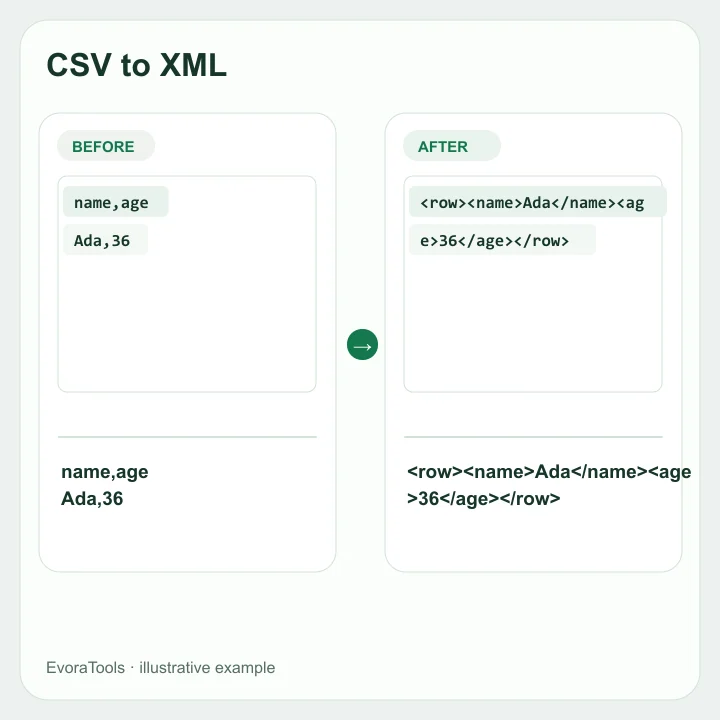
Convert CSV rows into XML elements.
Runs locally — files stay on your deviceWhat this tool does
CSV to XML convert CSV rows into XML elements. The page accepts a focused input and displays a result that can be copied into another workflow. Check generated values and remote responses against the actual destination before publishing or acting on the result. The supplied input is processed locally in the browser.
What is the quickest way to csv to xml?
Enter the requested input, run CSV to XML, and use the returned csv to xml result.
Understanding csv
Developer data formats depend on precise syntax and interoperability rules. Formatting changes presentation, validation checks grammar, and conversion maps one data model into another. For this page, the specific intent is csv to xml; that boundary distinguishes it from broader tools in Developer Tools.
How it works
The tool applies the named parser or deterministic transformation, reports malformed input instead of executing it, and returns text that can be copied into a development workflow. Here, the relevant input is the requested input, and the output is tailored to csv to xml.
Key concepts
CSV to XML input and result
The input is the requested input. The output represents csv to xml, so review its format before reuse.
Why csv to xml matters
A dedicated csv to xml workflow reduces ambiguity: the operation has one stated intent and does not silently perform unrelated changes.
When to use it
- Debug an API payload or configuration file when the goal is csv to xml.
- Prepare data for another toolchain when the goal is csv to xml.
- Spot syntax and structural problems before integration when the goal is csv to xml.
When not to use it
- Valid syntax does not guarantee a payload matches an application schema.
- Review numeric precision and unsupported data types after conversion.
- Never execute generated output without reviewing it.
Worked examples
Typical csv task
- Input
Representative csv to xml input- Expected output
A csv to xml result ready to review
This demonstrates the primary intent described by CSV to XML.
CSV to XML boundary check
- Input
Input containing spaces, punctuation, or an edge case- Expected output
A validated csv to xml result or a clear input error
Boundary values reveal the unit, syntax, range, and formatting assumptions specific to CSV to XML.
Using the CSV to XML output
- Input
Input prepared for a downstream developer tools workflow- Expected output
Output copied or downloaded for the destination system
The final destination determines the precision, format, and review needed after csv to xml.
Common mistakes
Using the wrong csv input
Valid syntax does not guarantee a payload matches an application schema. Correction: Confirm that the requested input matches the page labels.
Skipping review after csv to xml
Review numeric precision and unsupported data types after conversion. Correction: Compare the result with the original and its destination requirements.
Expecting CSV to XML to do more
Never execute generated output without reviewing it. Correction: Use a related tool when the task extends beyond csv to xml.
Best practices
- Keep an original copy before using CSV to XML.
- Use consistent input formats and units for csv to xml.
- Review the CSV to XML result in the system where it will be used.
Related operations and differences
XML to CSV
Choose XML to CSV when you need to convert repeated XML elements into CSV rows.; use CSV to XML specifically for csv to xml.
CSV to YAML
Choose CSV to YAML when you need to convert CSV rows into YAML.; use CSV to XML specifically for csv to xml.
YAML to CSV
Choose YAML to CSV when you need to convert a YAML array into CSV.; use CSV to XML specifically for csv to xml.
CSV Column Renamer
Choose CSV Column Renamer when you need to rename a CSV column.; use CSV to XML specifically for csv to xml.
CSV Column Reorder Tool
Choose CSV Column Reorder Tool when you need to reorder CSV columns by header name.; use CSV to XML specifically for csv to xml.
CSV Data Type Detector
Choose CSV Data Type Detector when you need to detect likely data types for each column.; use CSV to XML specifically for csv to xml.
Limitations and privacy
- Conversions can only preserve concepts shared by both formats.
- Parser error wording and edge-case support depend on the bundled standards-based library.
The supplied input is processed locally in this browser.
Frequently asked questions
What does CSV to XML do?
It convert CSV rows into XML elements. The operation is limited to csv to xml and does not infer requirements that are not shown.
What input should I use for csv to xml?
Use representative input that matches the format described by the page and its file picker or text area.
How should I interpret the CSV to XML result?
Treat the output as the direct result of csv to xml. Check it in the destination context, especially when rounding, formatting, metadata, or irreversible file changes matter.
What limitations apply to CSV to XML?
Conversions can only preserve concepts shared by both formats. Parser error wording and edge-case support depend on the bundled standards-based library.