CSV Merger
Merge compatible CSV datasets pasted together.
Runs locally — files stay on your deviceWhat this tool does
CSV Merger merge compatible CSV datasets pasted together. The page accepts a focused input and displays a result that can be copied into another workflow. Check generated values and remote responses against the actual destination before publishing or acting on the result. The supplied input is processed locally in the browser.
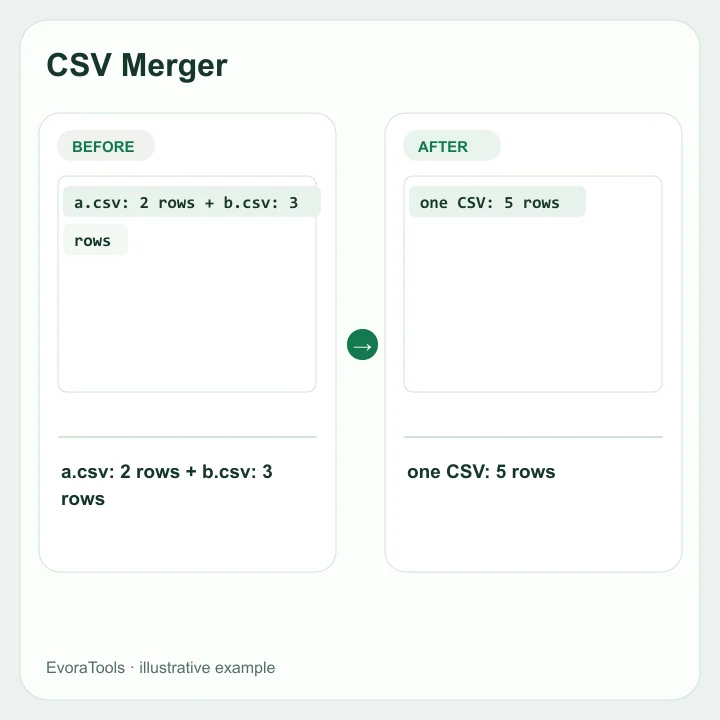
What is the quickest way to csv merger?
Enter the requested input, run CSV Merger, and use the returned csv merger result.
Understanding csv
Developer data formats depend on precise syntax and interoperability rules. Formatting changes presentation, validation checks grammar, and conversion maps one data model into another. For this page, the specific intent is csv merger; that boundary distinguishes it from broader tools in Developer Tools.
How it works
The tool applies the named parser or deterministic transformation, reports malformed input instead of executing it, and returns text that can be copied into a development workflow. Here, the relevant input is the requested input, and the output is tailored to csv merger.
Key concepts
CSV Merger input and result
The input is the requested input. The output represents csv merger, so review its format before reuse.
Why csv merger matters
A dedicated csv merger workflow reduces ambiguity: the operation has one stated intent and does not silently perform unrelated changes.
When to use it
- Debug an API payload or configuration file when the goal is csv merger.
- Prepare data for another toolchain when the goal is csv merger.
- Spot syntax and structural problems before integration when the goal is csv merger.
When not to use it
- Valid syntax does not guarantee a payload matches an application schema.
- Review numeric precision and unsupported data types after conversion.
- Never execute generated output without reviewing it.
Worked examples
Typical csv task
- Input
Representative csv merger input- Expected output
A csv merger result ready to review
This demonstrates the primary intent described by CSV Merger.
CSV Merger boundary check
- Input
Input containing spaces, punctuation, or an edge case- Expected output
A validated csv merger result or a clear input error
Boundary values reveal the unit, syntax, range, and formatting assumptions specific to CSV Merger.
Using the CSV Merger output
- Input
Input prepared for a downstream developer tools workflow- Expected output
Output copied or downloaded for the destination system
The final destination determines the precision, format, and review needed after csv merger.
Common mistakes
Using the wrong csv input
Valid syntax does not guarantee a payload matches an application schema. Correction: Confirm that the requested input matches the page labels.
Skipping review after csv merger
Review numeric precision and unsupported data types after conversion. Correction: Compare the result with the original and its destination requirements.
Expecting CSV Merger to do more
Never execute generated output without reviewing it. Correction: Use a related tool when the task extends beyond csv merger.
Best practices
- Keep an original copy before using CSV Merger.
- Use consistent input formats and units for csv merger.
- Review the CSV Merger result in the system where it will be used.
Related operations and differences
CSV Column Renamer
Choose CSV Column Renamer when you need to rename a CSV column.; use CSV Merger specifically for csv merger.
CSV Column Reorder Tool
Choose CSV Column Reorder Tool when you need to reorder CSV columns by header name.; use CSV Merger specifically for csv merger.
CSV Data Type Detector
Choose CSV Data Type Detector when you need to detect likely data types for each column.; use CSV Merger specifically for csv merger.
CSV Delimiter Converter
Choose CSV Delimiter Converter when you need to convert between CSV delimiters.; use CSV Merger specifically for csv merger.
CSV Empty Row Remover
Choose CSV Empty Row Remover when you need to remove completely empty CSV rows.; use CSV Merger specifically for csv merger.
CSV Encoding Converter
Choose CSV Encoding Converter when you need to normalize CSV text into UTF-8 output.; use CSV Merger specifically for csv merger.
Limitations and privacy
- Conversions can only preserve concepts shared by both formats.
- Parser error wording and edge-case support depend on the bundled standards-based library.
The supplied input is processed locally in this browser.
Frequently asked questions
What does CSV Merger do?
It merge compatible CSV datasets pasted together. The operation is limited to csv merger and does not infer requirements that are not shown.
What input should I use for csv merger?
Use representative input that matches the format described by the page and its file picker or text area.
How should I interpret the CSV Merger result?
Treat the output as the direct result of csv merger. Check it in the destination context, especially when rounding, formatting, metadata, or irreversible file changes matter.
What limitations apply to CSV Merger?
Conversions can only preserve concepts shared by both formats. Parser error wording and edge-case support depend on the bundled standards-based library.