URL Parser
Inspect URL components and parameters.
Runs locally — files stay on your deviceWhat this tool does
URL Parser inspect URL components and parameters. The page accepts a focused input and displays a result that can be copied into another workflow. Check generated values and remote responses against the actual destination before publishing or acting on the result. The supplied input is processed locally in the browser.
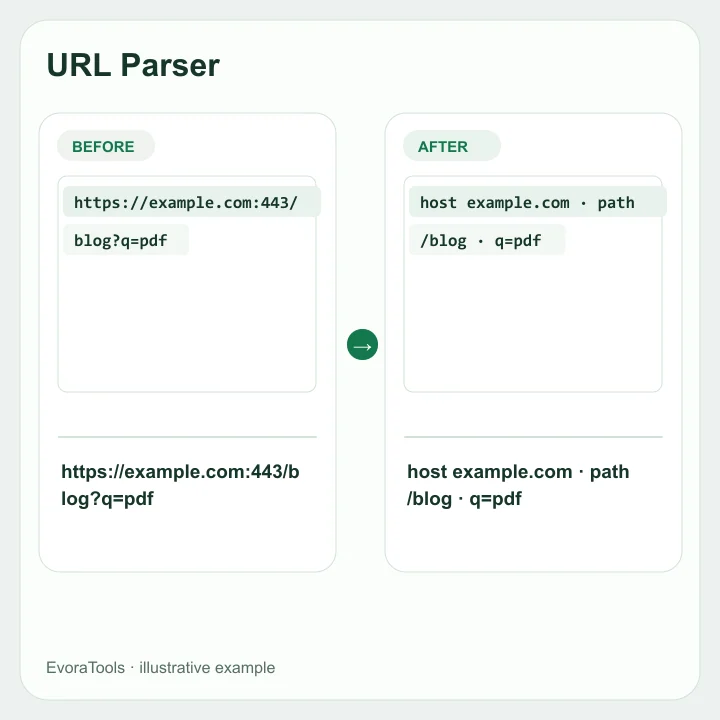
What is the quickest way to url parse?
Enter the requested input, run URL Parser, and use the returned url parse result.
Understanding url
This utility applies one focused transformation to the supplied input. For this page, the specific intent is url parse; that boundary distinguishes it from broader tools in SEO.
How it works
Enter the requested values, run the operation, and review the result before copying or downloading it. Here, the relevant input is the requested input, and the output is tailored to url parse.
Key concepts
URL Parser input and result
The input is the requested input. The output represents url parse, so review its format before reuse.
Why url parse matters
A dedicated url parser workflow reduces ambiguity: the operation has one stated intent and does not silently perform unrelated changes.
When to use it
- Complete a focused digital task when the goal is url parse.
- Prepare consistent output when the goal is url parse.
- Check a result before reuse when the goal is url parse.
When not to use it
- Review the output in its destination context.
- Keep the original input when the change is irreversible.
- Do not infer guarantees beyond the displayed result.
Worked examples
Typical url task
- Input
Representative url parser input- Expected output
A url parse result ready to review
This demonstrates the primary intent described by URL Parser.
URL Parser boundary check
- Input
Input containing spaces, punctuation, or an edge case- Expected output
A validated url parse result or a clear input error
Boundary values reveal the unit, syntax, range, and formatting assumptions specific to URL Parser.
Using the URL Parser output
- Input
Input prepared for a downstream seo workflow- Expected output
Output copied or downloaded for the destination system
The final destination determines the precision, format, and review needed after url parse.
Common mistakes
Using the wrong url input
Review the output in its destination context. Correction: Confirm that the requested input matches the page labels.
Skipping review after url parse
Keep the original input when the change is irreversible. Correction: Compare the result with the original and its destination requirements.
Expecting URL Parser to do more
Do not infer guarantees beyond the displayed result. Correction: Use a related tool when the task extends beyond url parse.
Best practices
- Keep an original copy before using URL Parser.
- Use consistent input formats and units for url parse.
- Review the URL Parser result in the system where it will be used.
Related operations and differences
Canonical URL Checker
Choose Canonical URL Checker when you need to compare a page canonical with its requested URL.; use URL Parser specifically for url parse.
Sitemap URL Extractor
Choose Sitemap URL Extractor when you need to extract loc URLs from XML sitemap text.; use URL Parser specifically for url parse.
URL Query Parameter Editor
Choose URL Query Parameter Editor when you need to add or update a URL query parameter.; use URL Parser specifically for url parse.
URL Query Parameter Remover
Choose URL Query Parameter Remover when you need to remove a URL query parameter.; use URL Parser specifically for url parse.
Website Redirect Checker
Choose Website Redirect Checker when you need to inspect the final URL after redirects.; use URL Parser specifically for url parse.
Website Response Header Checker
Choose Website Response Header Checker when you need to inspect response headers of a public website.; use URL Parser specifically for url parse.
Limitations and privacy
- Results depend on browser support and valid input.
The supplied input is processed locally in this browser.
Frequently asked questions
What does URL Parser do?
It inspect URL components and parameters. The operation is limited to url parse and does not infer requirements that are not shown.
What input should I use for url parser?
Use representative input that matches the format described by the page and its file picker or text area.
How should I interpret the URL Parser result?
Treat the output as the direct result of url parse. Check it in the destination context, especially when rounding, formatting, metadata, or irreversible file changes matter.
What limitations apply to URL Parser?
Results depend on browser support and valid input.