Protect PDF with Password
Encrypt a PDF with a password.
Uses protected server processingWhat this tool does
Protect PDF with Password sends the selected file and password to the EvoraTools server over HTTPS, uses qpdf AES-256 encryption, returns the protected document, and removes temporary processing files after the request. Keep the original document, inspect the generated result before sharing it, and use specialist software whenever legal, archival, print-production, or certification requirements extend beyond this focused workflow.
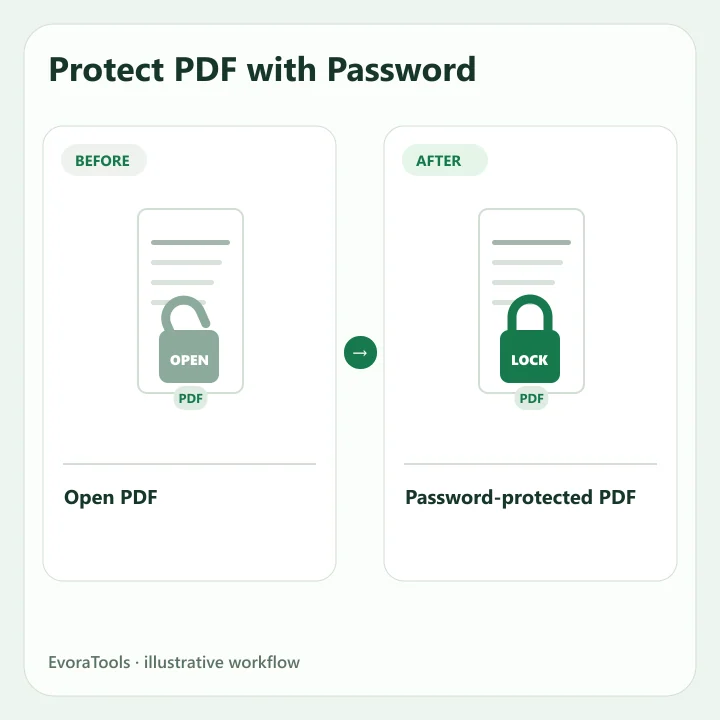
What is the quickest way to protect?
Enter Password, run Protect PDF with Password, and use the returned protect result.
Understanding pdf
PDF files contain page objects and shared resources such as fonts, images, forms, links, and metadata. Page-level operations may preserve visible content without preserving every advanced document feature. For this page, the specific intent is protect; that boundary distinguishes it from broader tools in PDF.
How it works
The selected document is loaded in browser memory, the requested page or metadata operation is applied, and a new PDF is created for download. Here, the relevant input is Password, and the output is tailored to protect.
Key concepts
Protect PDF with Password input and result
The input is Password. The output represents protect, so review its format before reuse.
Why protect matters
A dedicated protect pdf with password workflow reduces ambiguity: the operation has one stated intent and does not silently perform unrelated changes.
When to use it
- Reorganize a document before sharing when the goal is protect.
- Inspect pages or metadata without uploading the file when the goal is protect.
- Create a focused PDF from existing material when the goal is protect.
When not to use it
- Keep the original before deleting, cropping, flattening, or reordering pages.
- Verify forms, signatures, bookmarks, and annotations after processing.
- Select page ranges carefully because numbering starts at one in the interface.
Worked examples
Typical pdf task
- Input
Password = representative input- Expected output
A protect result ready to review
This demonstrates the primary intent described by Protect PDF with Password.
Protect PDF with Password boundary check
- Input
Password = representative input- Expected output
A validated protect result or a clear input error
Boundary values reveal the unit, syntax, range, and formatting assumptions specific to Protect PDF with Password.
Using the Protect PDF with Password output
- Input
Password = representative input- Expected output
Output copied or downloaded for the destination system
The final destination determines the precision, format, and review needed after protect.
Common mistakes
Using the wrong pdf input
Keep the original before deleting, cropping, flattening, or reordering pages. Correction: Confirm that Password matches the page labels.
Skipping review after protect
Verify forms, signatures, bookmarks, and annotations after processing. Correction: Compare the result with the original and its destination requirements.
Expecting Protect PDF with Password to do more
Select page ranges carefully because numbering starts at one in the interface. Correction: Use a related tool when the task extends beyond protect.
Best practices
- Keep an original copy before using Protect PDF with Password.
- Use consistent input formats and units for protect.
- Review the Protect PDF with Password result in the system where it will be used.
Related operations and differences
Add Header and Footer to PDF
Choose Add Header and Footer to PDF when you need to add reusable header and footer text to PDF pages.; use Protect PDF with Password specifically for protect.
Add Image Watermark to PDF
Choose Add Image Watermark to PDF when you need to overlay an image watermark on every PDF page.; use Protect PDF with Password specifically for protect.
Compare Two PDF Files
Choose Compare Two PDF Files when you need to compare two PDFs by pages and extracted text.; use Protect PDF with Password specifically for protect.
Compress PDF
Choose Compress PDF when you need to reduce PDF size while keeping searchable text in normal modes.; use Protect PDF with Password specifically for protect.
Extract Images from PDF
Choose Extract Images from PDF when you need to extract downloadable image content from PDF pages.; use Protect PDF with Password specifically for protect.
Fill PDF Form
Choose Fill PDF Form when you need to detect and complete interactive PDF form fields.; use Protect PDF with Password specifically for protect.
Limitations and privacy
- Encrypted, damaged, or unusually complex PDFs may not load.
- Digital signatures and advanced interactive features may not survive creation of a new document.
The PDF and password are transmitted to the EvoraTools server for temporary processing.
Temporary files are removed after the request; normal infrastructure access logs may still exist.
Frequently asked questions
What does Protect PDF with Password do?
It encrypt a PDF with a password. The operation is limited to protect and does not infer requirements that are not shown.
What input should I use for protect pdf with password?
Use Password in the units or format shown beside each field.
How should I interpret the Protect PDF with Password result?
Treat the output as the direct result of protect. Check it in the destination context, especially when rounding, formatting, metadata, or irreversible file changes matter.
What limitations apply to Protect PDF with Password?
Encrypted, damaged, or unusually complex PDFs may not load. Digital signatures and advanced interactive features may not survive creation of a new document.