Contribution Margin Calculator
Calculate contribution per unit and margin.
Runs locally — files stay on your deviceWhat this tool does
Contribution Margin Calculator calculate contribution per unit and margin. The page accepts a focused input and displays a result that can be copied into another workflow. Check generated values and remote responses against the actual destination before publishing or acting on the result. The supplied input is processed locally in the browser.
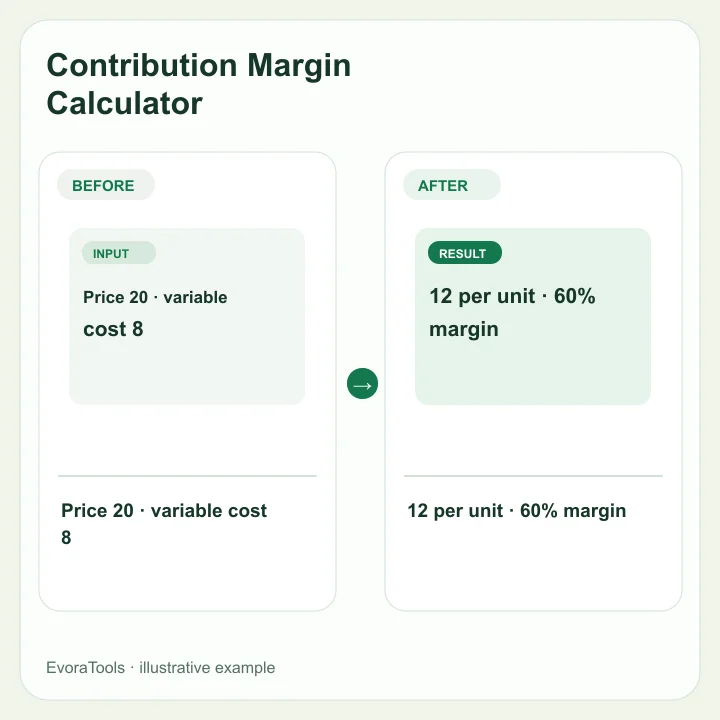
What is the quickest way to contribution margin calculator?
Enter Price, Variable, run Contribution Margin Calculator, and use the returned contribution margin calculator result.
Understanding contribution
Business metrics summarize relationships among revenue, cost, customers, and time. A useful result depends on consistent definitions and reporting periods. For this page, the specific intent is contribution margin calculator; that boundary distinguishes it from broader tools in Business.
How it works
Provide values from the same scope and period. The calculator applies the metric formula and reports a value intended for interpretation alongside the source data. Here, the relevant input is Price, Variable, and the output is tailored to contribution margin calculator.
Key concepts
Contribution Margin Calculator input and result
The input is Price, Variable. The output represents contribution margin calculator, so review its format before reuse.
Why contribution margin calculator matters
A dedicated contribution margin calculator workflow reduces ambiguity: the operation has one stated intent and does not silently perform unrelated changes.
When to use it
- Check a KPI calculation when the goal is contribution margin calculator.
- Compare operating scenarios when the goal is contribution margin calculator.
- Explain how one business input affects a result when the goal is contribution margin calculator.
When not to use it
- Use consistent accounting definitions across periods.
- Do not compare percentages built from different populations.
- Document exclusions, refunds, taxes, and one-off costs.
Worked examples
Typical contribution task
- Input
Price = 25; Variable = 25- Expected output
A contribution margin calculator result ready to review
This demonstrates the primary intent described by Contribution Margin Calculator.
Contribution Margin Calculator boundary check
- Input
Price = 0; Variable = 0- Expected output
A validated contribution margin calculator result or a clear input error
Boundary values reveal the unit, syntax, range, and formatting assumptions specific to Contribution Margin Calculator.
Using the Contribution Margin Calculator output
- Input
Price = 25; Variable = 25- Expected output
Output copied or downloaded for the destination system
The final destination determines the precision, format, and review needed after contribution margin calculator.
Common mistakes
Using the wrong contribution input
Use consistent accounting definitions across periods. Correction: Confirm that Price, Variable matches the page labels.
Skipping review after contribution margin calculator
Do not compare percentages built from different populations. Correction: Compare the result with the original and its destination requirements.
Expecting Contribution Margin Calculator to do more
Document exclusions, refunds, taxes, and one-off costs. Correction: Use a related tool when the task extends beyond contribution margin calculator.
Best practices
- Keep an original copy before using Contribution Margin Calculator.
- Use consistent input formats and units for contribution margin calculator.
- Review the Contribution Margin Calculator result in the system where it will be used.
Related operations and differences
Operating Margin Calculator
Choose Operating Margin Calculator when you need to calculate operating income as a share of revenue.; use Contribution Margin Calculator specifically for contribution margin calculator.
Annual Recurring Revenue Calculator
Choose Annual Recurring Revenue Calculator when you need to annualize monthly recurring revenue.; use Contribution Margin Calculator specifically for contribution margin calculator.
Average Order Value Calculator
Choose Average Order Value Calculator when you need to calculate revenue per order.; use Contribution Margin Calculator specifically for contribution margin calculator.
Break-Even Point Calculator
Choose Break-Even Point Calculator when you need to calculate units needed to cover fixed costs.; use Contribution Margin Calculator specifically for contribution margin calculator.
Click-Through Rate Calculator
Choose Click-Through Rate Calculator when you need to calculate clicks as a share of impressions.; use Contribution Margin Calculator specifically for contribution margin calculator.
Cost per Acquisition Calculator
Choose Cost per Acquisition Calculator when you need to calculate advertising cost per acquired customer.; use Contribution Margin Calculator specifically for contribution margin calculator.
Limitations and privacy
- A single metric cannot describe overall business health.
- The result is only as reliable as the entered data.
The supplied input is processed locally in this browser.
Frequently asked questions
What does Contribution Margin Calculator do?
It calculate contribution per unit and margin. The operation is limited to contribution margin calculator and does not infer requirements that are not shown.
What input should I use for contribution margin calculator?
Use Price, Variable in the units or format shown beside each field.
How should I interpret the Contribution Margin Calculator result?
Treat the output as the direct result of contribution margin calculator. Check it in the destination context, especially when rounding, formatting, metadata, or irreversible file changes matter.
What limitations apply to Contribution Margin Calculator?
A single metric cannot describe overall business health. The result is only as reliable as the entered data.